.png)
Manganese Deficiency Palm Tree Repair: A Specialist’s Guide to Saving Frizzle Top Palms

That shriveled, "frizzled" new growth on your palm isn't just an eyesore; it's a biological SOS that could lead to the permanent loss of a mature, multi-thousand-dollar asset. Many property owners mistake these symptoms for a death sentence, often confusing nutritional collapse with fatal pathogens like Lethal Bronzing. If you've spent money on generic spikes only to see the canopy continue to wither, you understand the frustration of treating a symptom without addressing the underlying soil chemistry. Effective manganese deficiency palm tree repair requires a precise, diagnostic approach to unlock the nutrients trapped by Florida's often alkaline soil.
We understand the protective concern you feel for your landscape's health. This specialist's guide will show you how to accurately diagnose Frizzle Top and implement a corrective strategy to save your palms from irreversible decline. You'll learn to distinguish between malnutrition and disease, navigate the critical seasonal fertilizer bans in counties like Hillsborough and Pinellas, and establish a preventative nutrient plan. By following this methodical path, you can stop the progression of Frizzle Top and restore a vibrant, healthy canopy to your palms.
Key Takeaways
Identify the specific "frizzled" and scorched indicators of micronutrient starvation before the palm's crown reaches a point of total collapse.
Learn why Florida's alkaline soil chemistry causes vital minerals to become insoluble, regardless of how much generic fertilizer you apply.
Master the diagnostic precision required for effective manganese deficiency palm tree repair by distinguishing nutritional symptoms from fatal bacterial diseases.
Implement a methodical repair protocol that addresses both the immediate nutrient deficit and the underlying soil pH imbalances.
Transition from reactive treatment to proactive stewardship with a quarterly nutrient plan designed for long-term landscape preservation.
Table of Contents
Recognizing Manganese Deficiency: The "Frizzle Top" Threat
Manganese (Mn) deficiency is more than a minor nutrient imbalance; it's a state of micronutrient starvation that aggressively targets the palm's newest growth. When a palm tree lacks this essential mineral, it cannot produce the chlorophyll needed for basic survival. This physiological breakdown manifests as "Frizzle Top," a term specialists use to describe the scorched, curled, and necrotic appearance of leaflets as they emerge from the center of the canopy. While many species suffer from manganese deficiency in plants, palms exhibit some of the most dramatic and devastating symptoms due to their unique growth patterns.
In Florida's landscapes, certain species are particularly vulnerable to this decline. Queen palms, Royal palms, and Sago palms are frequently the first to show signs of distress. If you ignore these early indicators, the biological progression is unforgiving. Without timely manganese deficiency palm tree repair, the palm's growth will eventually cease entirely. This leads to the death of the terminal bud, which is the palm's only growing point. Once the terminal bud dies, the tree cannot be saved, resulting in the total loss of a mature landscape asset.
Early Warning Signs in the Canopy
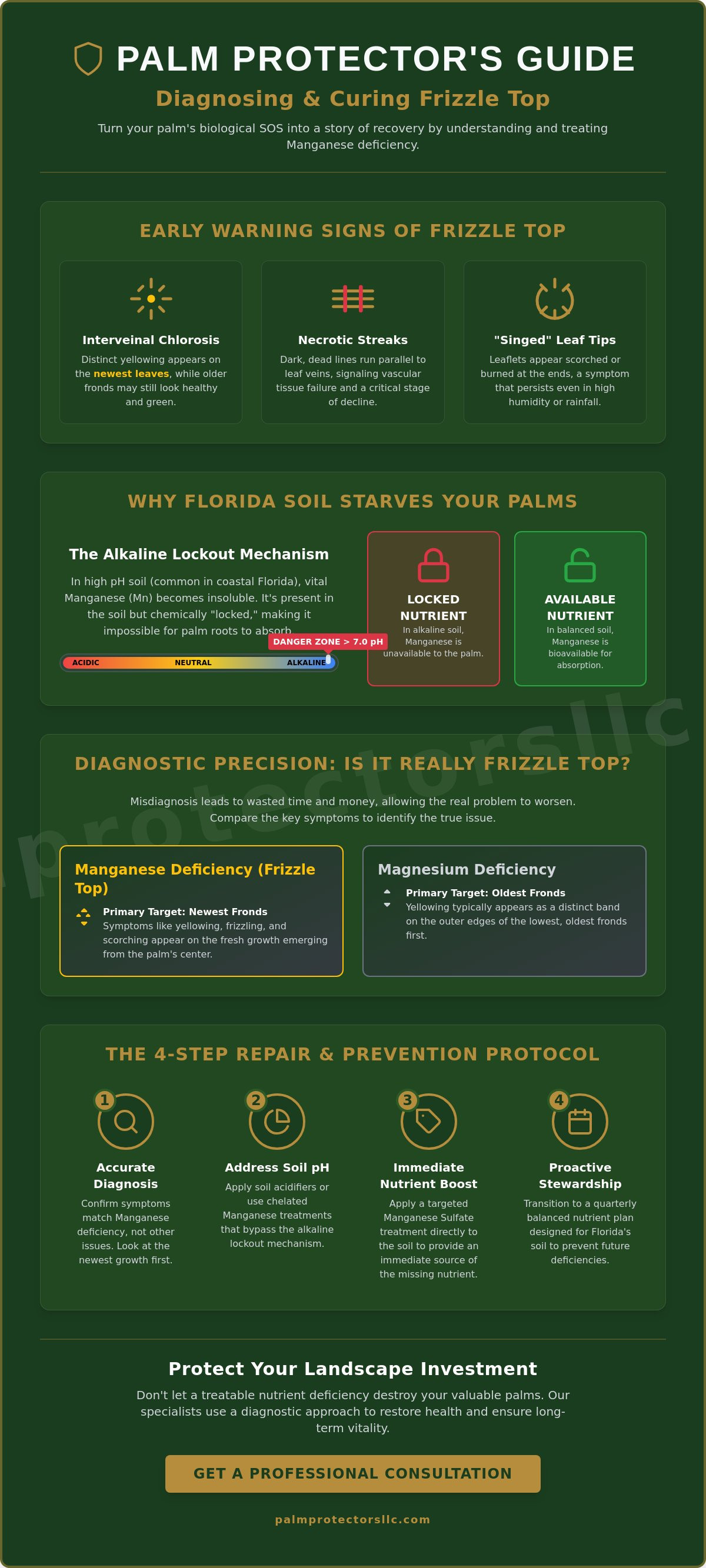
The first indicators of trouble are often subtle and require a vigilant eye. Look for interveinal chlorosis, which is a distinct yellowing on the newest leaves while the older fronds might still appear green. Unlike general yellowing, this starts specifically at the base of the newest leaflets. You should also identify longitudinal necrotic streaks. These are dark, dead lines that run parallel to the leaf veins, signaling that the vascular tissue is already beginning to fail. Another hallmark sign is "singed" leaf tips. These leaflets appear burned or scorched at the ends, a symptom that persists even during periods of heavy rainfall or high humidity.
The Progression Toward Terminal Decline
As the deficiency advances, the palm's condition moves from aesthetic damage to systemic failure. New leaves no longer emerge with their full length; instead, they appear as stunted, brown stubs that look like they've been through a fire. At this stage, the palm's ability to photosynthesize is severely compromised. This lack of energy production causes a rapid decline in overall vigor. A weakened palm is a target for further complications. Once malnutrition has compromised the tree's natural defenses, secondary pathogens and opportunistic pests often move in to accelerate the decline. Identifying these symptoms early is the only way to ensure a successful manganese deficiency palm tree repair before the damage becomes terminal.
The Biological Cause: Why Florida Soil Starves Your Palms
Florida's landscape is visually stunning, but beneath the surface, the soil chemistry often works against the health of your palms. In coastal regions like Tampa and St. Petersburg, the soil is frequently alkaline, meaning the pH level exceeds 7.0. This alkalinity isn't just a number; it's a chemical barrier. When pH rises, manganese becomes insoluble. It remains in the soil but stays in a form that roots cannot absorb. This is why a successful manganese deficiency palm tree repair involves more than just tossing fertilizer on the ground. You must address the chemical environment that caused the lockout in the first place.
The Alkaline Lockout Mechanism
The presence of calcium carbonate in Florida's coastal soils is the primary driver of this nutritional crisis. As soil pH climbs, the manganese ions bind tightly to soil particles, rendering them unavailable to the plant. Nutrient bioavailability refers to the specific form of a mineral that can actually be absorbed and utilized by the palm's vascular system. Simply adding more manganese to a high-pH environment is often futile. Without adjusting the soil's acidity or using specific delivery methods, the palm continues to starve despite the abundance of nutrients in the surrounding earth.
It's also vital to distinguish between manganese and magnesium, as the two are frequently confused by well-meaning property owners. While both are essential, they target different parts of the tree. Manganese deficiency, or Frizzle Top, strikes the newest fronds first. Magnesium deficiency, conversely, appears as yellowing on the oldest, lowest fronds. Treating one with the other is a wasted effort that allows the true problem to persist. If you're unsure which nutrient your tree is missing, seeking a professional Frizzle Top treatment can prevent costly diagnostic errors.
Nutrient Leaching in Sandy Soils
Florida’s environmental conditions further complicate nutrient management. Our sandy soils have poor cation exchange capacity, meaning they don't hold onto minerals well. During the heavy rainy season, which typically runs from June through September, water moves rapidly through the sand. This washes away soluble nutrients before the palm can take them up. This leaching is especially prevalent in new construction areas where "fill dirt" is used. This soil often lacks the organic matter necessary to retain micronutrients. Temperature also plays a role. During the cooler winter months, a palm's metabolic rate slows down, and cold soil further inhibits the roots' ability to transport manganese.
Finally, the "landscaper error" often exacerbates the issue. Many generic, high-nitrogen fertilizers stimulate rapid green growth. However, if the soil is already low in manganese, this forced growth puts an even higher demand on the tree's limited mineral reserves. This creates a "dilution effect" where the little manganese available is spread too thin, causing the palm to crash. According to the University of Florida's guide to Manganese Deficiency in Palms, proper fertilization must be balanced to avoid these induced deficiencies. Executing a manganese deficiency palm tree repair requires a deep understanding of these biological triggers to ensure long-term survival.
Diagnostic Precision: Distinguishing Manganese Deficiency from Lethal Bronzing
Correctly identifying the cause of a palm’s decline is the most critical step in landscape preservation. In Florida, property owners often confuse Frizzle Top with Lethal Bronzing Disease (LBD), but a misdiagnosis here is often fatal for the tree. While both conditions lead to canopy death, they operate through entirely different biological mechanisms. Treating a palm for nutritional needs when it actually harbors a phytoplasma infection is a wasted effort that allows a contagious threat to spread through your landscape. Achieving manganese deficiency palm tree repair requires a precise understanding of where the symptoms originate and how quickly they progress.
The primary differentiator is the location of the initial damage. Manganese deficiency is a micronutrient starvation that manifests in the newest growth first. You'll see shriveled, "frizzled" leaflets emerging from the center of the crown. In contrast, Lethal Bronzing typically affects the oldest, lowest fronds first, which take on a distinct reddish-bronze hue. According to the University of Florida's guide to Manganese Deficiency in Palms, visual cues are a starting point, but the speed of the decline often tells the real story. Nutrient deficiency is a slow, agonizing starvation that takes months to kill a palm. Lethal Bronzing is a rapid systemic infection that can collapse a healthy tree in just a few weeks.
Frizzle Top vs. Lethal Bronzing Checklist
To narrow down the threat, perform a methodical inspection of the palm's reproductive and structural health. Use the following indicators to assess the situation:
Premature Fruit Drop: If the palm is dropping its fruit or flowers suddenly and out of season, this is a strong indicator of Lethal Bronzing, not a nutrient issue.
Spear Leaf Health: In cases of Frizzle Top, the central spear leaf is often the last part of the canopy to die. In Lethal Bronzing, the spear leaf often collapses much earlier in the infection cycle.
Color Profile: Look for the "bronzing" effect. If the fronds are turning a deep, reddish-brown rather than a scorched yellow-brown, the threat is likely pathological.
If your palm exhibits these rapid, bronze symptoms, you should immediately investigate Lethal Bronzing Disease protection Florida to prevent the loss of neighboring trees.
When to Call a Specialist for Testing
Visual DIY diagnosis has severe limitations, especially when protecting high-value, mature palms. Because the symptoms of manganese deficiency palm tree repair can sometimes overlap with other stressors, professional diagnostic testing is the only way to be certain. Specialists use trunk sampling and molecular tissue analysis to detect the presence of DNA from the LBD phytoplasma. A "wait and see" strategy is the most dangerous approach you can take. If the issue is nutritional, every day without intervention brings the terminal bud closer to death. If the issue is disease, delay allows the infection to become a reservoir for local insect vectors.
The Repair Protocol: Restoring Vitality to Nutrient-Deficient Palms
Restoring a palm from advanced micronutrient starvation is a medical intervention that requires a disciplined, multi-stage protocol. You cannot expect a single application to reverse months of biological decline. A successful manganese deficiency palm tree repair follows a logical progression that first corrects the soil's chemical environment before delivering the specific minerals needed to stimulate new growth. This process is about changing the underlying biology of the root zone to ensure the tree can sustain itself long after the initial treatment.
The repair protocol consists of four essential steps designed to stop the decline and trigger a recovery:
Step 1: Soil pH Adjustment — We apply elemental sulfur or acidic amendments to lower the soil pH. This "unlocks" the manganese already present in the ground, making it soluble and available for root uptake.
Step 2: Targeted Manganese Sulfate Application — Once the soil environment is primed, we deliver manganese sulfate in a bioavailable form. This ensures the tree has an immediate and abundant supply of the specific mineral it has been lacking.
Step 3: Foliar Nutritional Sprays — While the roots begin to process soil nutrients, we apply a liquid mineral wash directly to the canopy. This provides an immediate "medical" boost to the palm's metabolic processes.
Step 4: Monitoring and Iteration — We track the palm's progress over several months. As the first flush of new growth appears, we adjust the nutrient plan to ensure the recovery remains on a steady, healthy trajectory.
Soil Drenching vs. Foliar Application
Choosing the right delivery method is a matter of balancing long-term health with immediate survival. Soil drenches are the foundation of stability, but they are slow-acting because the nutrients must travel through the entire vascular system from the ground up. Conversely, foliar sprays act as a life-saving "IV drip" for a starving palm, allowing the tree to absorb manganese almost instantly through its foliage. This immediate intake is often what prevents the final death of the terminal bud. It's vital to remember that palm fronds don't "heal" once they are damaged; once a leaf is scorched or shriveled, the cellular damage is permanent and those specific fronds will never turn green again.
The Recovery Timeline
Patience is a requirement for professional stewardship. It typically takes 6 to 12 months to see a full canopy of healthy growth return to a treated palm. You'll know the manganese deficiency palm tree repair is working when the first healthy spear leaf emerges from the center of the crown. This new growth should be flexible, vibrant, and entirely free of necrotic streaks. Resist the urge to prune away the unsightly, frizzled fronds during this time. Even a damaged frond contributes a small amount of photosynthetic energy, and removing them prematurely can further stress a palm that is already in a fragile state of recovery.
If your landscape assets are showing signs of collapse, immediate action is the only way to prevent total loss. You can secure a professional Frizzle Top treatment to arrest the decline and begin the methodical repair process today.
Professional Stewardship: Long-Term Prevention in Tampa Bay
Achieving a permanent manganese deficiency palm tree repair is only possible through a commitment to consistent, science-based maintenance. Once you've arrested the immediate decline of Frizzle Top, the focus must shift from reactive crisis management to proactive stewardship. In Florida's nutrient-leached environment, a "wait and see" approach is a recipe for repeated failure. A quarterly nutrient schedule is non-negotiable for maintaining the structural integrity and biological health of your palms. We utilize professional-grade, slow-release fertilizers, specifically the 8-2-12+4Mg formulation. This balanced ratio ensures that while the palm receives necessary nitrogen, it's also fortified with the magnesium and manganese required to prevent a relapse into micronutrient starvation.
You should avoid "weed and feed" products at all costs. These generic retail blends often contain herbicides that are toxic to palm roots. While they may temporarily green up your lawn, they can cause systemic damage to your trees, leading to stunted growth and increased susceptibility to pathogens. True protection requires a targeted strategy that treats the palm as a primary biological asset rather than an afterthought to turf maintenance. Palm Protectors LLC serves as the vigilant guardian of your landscape, ensuring that every application supports the long-term vitality of your canopy and the health of the surrounding ecosystem.
Creating a Nutrient Management Plan
Soil variations across Pasco, Pinellas, and Hillsborough counties require customized protocols. Coastal Pinellas often faces higher alkalinity than inland Pasco, necessitating different pH-adjustment strategies. We also meticulously navigate the seasonal fertilizer bans in the Tampa Bay area. From June 1st to September 30th, nitrogen and phosphorus applications are prohibited in several counties to protect our waterways from nutrient runoff. Professional monitoring ensures your trees receive consistent micronutrient delivery during these restricted windows. This catches deficiencies before they manifest as visual "Frizzle Top" symptoms, keeping your palms resilient even when traditional fertilizers are restricted.
Why Specialized Care Trumps General Landscaping
There is a vast difference between aesthetic maintenance and botanical medicine. General landscapers often focus on a "mow and blow" approach, which frequently leads to improper pruning. Removing too many green fronds, sometimes called "hurricane cutting," strips the tree of its vital nutrient reserves. This creates physiological stress that can trigger a rapid nutrient decline. Our specialized focus means we treat your palms with the diagnostic precision they deserve, focusing on biological health over mere appearance. Protect your palms with a professional health assessment to ensure your landscape remains a resilient, vibrant asset for years to come.
Securing the Future of Your Florida Canopy
The shriveled leaves of Frizzle Top are a clear warning that your landscape's biological foundation is under stress. As discussed, a successful manganese deficiency palm tree repair requires a precise adjustment of soil pH to unlock vital nutrients trapped by alkaline conditions. By distinguishing these nutritional needs from the rapid, systemic threat of Lethal Bronzing, you ensure your intervention is both accurate and effective. Neglecting these early signs often leads to terminal bud death; however, proactive care can reverse the decline.
True preservation is a continuous process of vigilant stewardship. Our Certified Palm Health Technicians provide specialized Frizzle Top and Lethal Bronzing treatments throughout Tampa, St. Pete, and Pinellas County. We prioritize the science of botanical health to prevent irreversible loss and maintain the vibrant canopy your property deserves. Don't let a treatable deficiency turn into a permanent loss. Request a Professional Palm Health Consultation in Tampa Bay today. With specialized diagnostic care, your palms can remain a resilient and beautiful part of your landscape for years to come.
Frequently Asked Questions
Can a palm tree recover from Frizzle Top?
Yes, a palm can recover from Frizzle Top as long as the terminal bud remains viable. Once the growing point at the center of the crown dies, the tree's biological functions cease permanently. Successful manganese deficiency palm tree repair depends on early diagnosis and immediate corrective action. By adjusting soil pH and providing bioavailable minerals, you can stimulate the production of healthy new fronds to replace the damaged canopy.
How much manganese sulfate should I apply to my palm tree?
The specific dosage of manganese sulfate depends on the palm's size and the severity of the soil's alkaline lockout. Generally, soil applications range from 1 to 5 pounds per tree, distributed evenly under the canopy. However, applying too much can lead to toxicity or further nutrient imbalances. A professional assessment is necessary to determine the exact amount required to bypass soil chemistry barriers without harming the root system.
Will the brown, frizzled leaves on my palm turn green again?
Brown, frizzled leaves will never turn green again because the cellular damage is permanent. Palm fronds don't have the biological capacity to "heal" necrotic tissue. Instead, the goal of treatment is to ensure the new growth emerging from the terminal bud is healthy and vibrant. Over time, these new fronds will replace the shriveled ones, eventually restoring the palm's aesthetic and structural integrity.
Is manganese deficiency contagious to other palm trees?
Manganese deficiency is a nutritional starvation, not a contagious pathogen, so it cannot spread from one tree to another like a virus. However, if one palm on your property shows symptoms, others likely will too. This happens because the palms are usually growing in the same alkaline soil environment. A site-wide diagnostic check is often necessary to prevent a cluster of trees from declining simultaneously.
How long does it take for manganese treatments to work?
You should expect to see the first signs of recovery within 3 to 6 months, though a full restoration takes longer. Because palms grow slowly, it often takes 12 months for a completely healthy canopy to develop. The first indicator of a successful manganese deficiency palm tree repair is the emergence of a flexible, green spear leaf that is free of scorched tips or longitudinal streaks.
What is the best fertilizer for palms in Tampa, Florida?
The most effective choice for Tampa landscapes is a professional-grade 8-2-12+4Mg slow-release fertilizer. This specific ratio provides the necessary balance of nitrogen, potassium, and magnesium while delivering essential micronutrients. It's also vital to follow local ordinances, such as the summer fertilizer bans in Hillsborough and Pinellas counties, which prohibit nitrogen and phosphorus applications from June through September to protect local water quality.
Can overwatering cause manganese deficiency?
Overwatering is a frequent trigger for micronutrient deficiencies in Florida's sandy landscapes. Excessive irrigation or heavy seasonal rainfall leaches soluble manganese deep into the soil, moving it beyond the reach of the palm's root zone. Additionally, saturated soil lacks the oxygen required for healthy root respiration, which significantly impairs the tree's ability to absorb and transport minerals to the growing canopy.
Does Frizzle Top only affect Queen Palms?
While Queen palms are notoriously susceptible to Frizzle Top, the condition affects many other species common in Florida. Royal palms, Sago palms, and Canary Island Date palms also face a high risk of micronutrient starvation in alkaline soils. Any palm species planted in high-pH environments or nutrient-poor fill dirt is vulnerable to this decline, making regular monitoring essential for all mature landscape palms.


Comments